

For publishers, the pressure never lets up. Buyers pushing for changes in what they buy and how it is measured. Creators exploring new social networks and formats. And let’s not forget platforms changing the rules with little to no consultation. Any one of these can present significant challenges for publishers of any size to manage, let alone all three at once.
One solution is to simplify sales and operations. Refuse opportunities for creators on emerging platforms. Prune down the media types and products that your team sells. Commit your business to a single host, knowing your livelihood depends on a company whose interests may not always align with yours or the creators you work with.
But there is another way: one that positions your organization for longer-term growth, increases your total available revenue cap, protects your business, your creators and your buyers, and provides streamlined offerings that change with the times.
Today I will be breaking down the components of successful simulcast strategies, sharing what works and what to watch out for. I’ve been working with podcasters since the earliest days of the medium, and now at Flightpath I have the joy to work with clients who are building the future of media.
For anyone looking for part two, you can find it here:
Simulcast Sales: Risks into Opportunities

I know from first-hand experience the pressures and challenges facing publishers and networks as they work to establish a successful business. Back in the early days of podcasting, I started the Fable and Folly Network, one of the first homes for fiction podcasts. New hosting platforms were springing up, touting tantalizing new features, not to mention …
The Case for Simulcast
Much, if not most, of the podcasting industry has come to terms with the idea of simulcast: the delivery of the same content across multiple platforms. Every active podcaster and creator has to address what platforms they will or won’t deliver to.
So it’s no surprise that publishers, networks and creators have had to address monetization across changing media types and platforms. Again, one way to do this is to pare down, by restricting what, where, and how advertising is sold. This desire to simplify options is understandable. Publishers are generally operating on low margins and limited internal resources. And the pressure to better align operations and sales only increases as complexity and costs grow.
The challenge, of course, is that change never stops. The forces we are discussing reappear constantly in new clothes and contexts. I expect anyone in our industry at the start of 2026 would have been able to cite the growth of video and the pressure to support baked-in ads based on Spotify and YouTube’s video rules. But few foresaw Google actively testing DAI with rollout slated for early 2027, or the signals from Apple that significant change may be coming to video and advertising in podcasts.
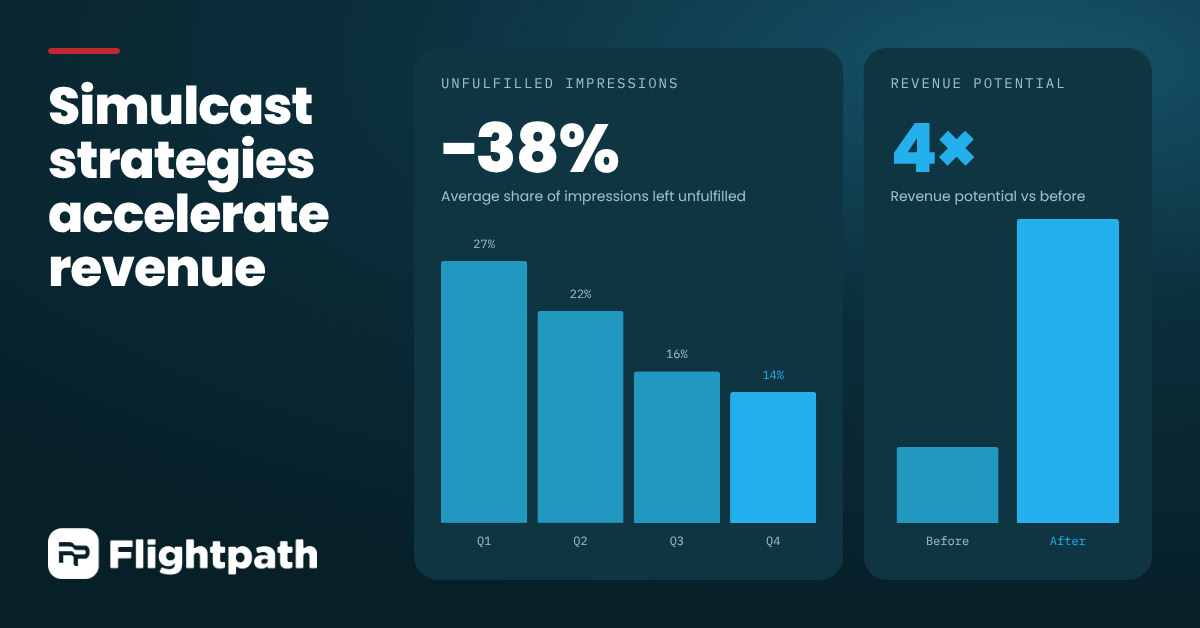
Sticking to a single platform and media type made some decisions simpler, like whether to use dynamic advertising with your direct sold campaigns. If your platform supported DAI, the increase in revenue potential made this decision worthwhile. But in a simulcast world, going dynamic-only leaves inventory unsellable on some platforms. On the other hand, going with only baked-in lowers your total revenue potential by up to 4x.
The result is that publishers are pressured to expand and redefine their products. And this introduces complexity that slows down sales, quickly overwhelms manual tools and creates operational challenges.
Given all this, how do we monetize the same content across multiple platforms?
Simulcast Sales Strategies
A sales strategy means being in the market with clearly defined, in-demand products. A good sales strategy makes it easier for your teams to sell, manage, deliver, and bill. But doing this in a way that can respond easily to changes in audience consumption, market consolidation, platform rules and buyer preferences can feel like an overwhelming task.
A simulcast sales strategy addresses these forces at scale across industries, platforms, and teams. A good simulcast sales strategy gives your sales team products that meet current and foreseeable demand. It should ensure that your processes align, uniting sales and operations with tools that streamline the management of inventory, availability, trafficking, and reporting. And most importantly, the strategy should directly address the need for future change.
Imagine a world where offering a new type of product to the market comes with no significant changes to your sales team’s workflows. And where operations and billing can support it immediately without having to rebuild any of their tools or systems. This creates resilience, not to mention first-mover advantage, and enables you to test products that lift your total revenue cap without harming existing relationships.
I expect it might help to break down the inputs and some starting questions to ask to help define a simulcast sales strategy.
The organization’s vision and goals. Where do we need to be in the ecosystem? And what creators do we want to attract and support? Are there any of these creators we can’t fully support, and why? What monetization channels are on the table today and what’s on the horizon?
The technology stack. Audit the existing and available systems with a focus on multi-platform support. What tools do we already have, and what else is available? Where are we unprepared? What is needed to unify sales and operations, to include products, inventory management, availability, trafficking, and reporting?
Sales positioning and pricing strategy. Can your sales team clearly define the opportunity? Are you creating a bundled opportunity on a sponsorship basis at a flat fee or a CPM model based on delivery per platform?
Campaign implementation. Is your operations team prepared to monitor campaign performance and make real-time adjustments as necessary to deliver on client expectations?
Without a simulcast strategy, publishers risk leaving significant revenue on the table, slowing down their sales team with unnecessary complexity, and overwhelming operations. Of course, the strategy is just the first step. Next, we need to align our tools, workflows and technical stack with the strategy. We’ll cover this in future posts.
Continue the Conversation
At Flightpath we have been supporting publishers with tools to streamline sales and operations for over 5 years. We’ve co-evolved as we learn what strategies work and witness the impacts across our client base.
We view a simulcast sales strategy as the single greatest tool for securing future resilience and growth, but it is also likely the most misunderstood concept in our industry. I hope this article has helped to shed some light on what I hope will become a crucial part of every publisher’s arsenal.
A little about us: we reinvented order management by layering traffic management on top of the leading cross-platform inventory prediction engine in the industry. We provide inventory management, consolidated reporting, real-time availability and forecasting built to support simulcast sales strategies. Not to mention our white glove consulting support from leaders in podcast operations and revenue.
I’d love to learn about the pressures you face. Or chat about your experience addressing simulcast monetization for your business.
Email me at: sean.howard@flightpath.fm