

I know from first-hand experience the pressures and challenges facing publishers and networks as they work to establish a successful business. Back in the early days of podcasting, I started the Fable and Folly Network, one of the first homes for fiction podcasts. New hosting platforms were springing up, touting tantalizing new features, not to mention revenue guarantees and offers of free hosting. Choosing among these felt like an easy decision. We were just selecting a host.
But were we?
I wish I had known then what I know now. And that I had stopped to understand the risks of building a business on top of a single third-party platform I didn’t control or fully understand. Everyone was doing it. We never stopped to consider the downside of having all of our eggs in one basket.
The years ahead would show all of us in the industry what happens when a platform’s features or policies suddenly change. Or worse, when their priorities diverge from ours, often with little to no advance notice.
Introducing the Technology Stack
In this installment, I’m going to share how podcast creators and networks can protect their businesses, create opportunity and build resilience by identifying and mitigating the risks in their technology stack.
A technology stack is simply the software required to run your business, both in-house and third-party. It’s what enables your teams to deliver podcasts to listeners, pull reports, monetize content, monitor campaigns, communicate, invoice and every other task we do that involves computers. A problem in your stack can have significant impacts to your business and to your customers.
But first, a quick recap on what we’ve covered so far.
In Part 1 of this series, we defined a simulcast sales strategy as how an organization meets buyer demand while simplifying how their teams sell, manage, deliver, and bill. Faced with tight margins and limited resources, publishers feel the pressure to restrict which platforms and products they support in order to simplify their operations, but this comes with significant costs and risks.
A good simulcast sales strategy lifts the revenue cap for the business and protects publishers and even grants first-mover advantage as conditions change. It expands the creators they can support and can also insulate them from social platform and technology changes. This ability to adapt is critical because platforms, buyer preferences, and audience habits have never stopped evolving and will continue to change for as long as entertainment media exists.
The Hidden Risks Baked Into Technology
It is critical that we understand the motivations and incentives that drive our partners, and that includes our hosting platforms. A hosting partner has revenue targets to achieve, and we need to know how they reach those targets.
Do they survive off our hosting fees? Or are they incentivized by selling our content? What if the incentive for making money off of our content suddenly dwarfs the hosting fees for a partner?
And: Could a shift in a platform’s incentives lead to a significant loss of revenue to our business?
We are not sitting this one out

Podcast publishers should be served by their technology partners, not beholden to them.
"We did everything we were told to do. And now we are flying blind and no one seems to know what is broken or if it’s even fixable.”
A recent change in a key hosting platform left many of our clients facing potential losses in the tens of thousands of dollars of monthly ad revenue per publisher. For companies whose technology stack was built almost entirely on this single host, this could have led to a business-ending event, if it wasn’t mitigated quickly.
This same dependency risk extends into distribution. Recently YouTube revised the way they defined a “view” with only 7 days’ notice, leaving publishers scrambling. Buyers were confused and even angry at what felt like a change to what they had been promised. A view was no longer a view.
A Technology Platform Audit
It’s time to share a framework that your team can use to identify and mitigate platform risks. But first I want to acknowledge that there is always risk in our technology stack. Understanding those risks is 80% of the battle. Then it’s about identifying the biggest ones and ensuring you have mitigation strategies in place to address them. A mitigation strategy can range from a fallback procedure all the way to replacing that part of your stack with a more dependable solution.
A platform audit identifies the partners and technologies that your business depends on, what happens when they fail or change who they serve, and how you will protect your business when this happens.
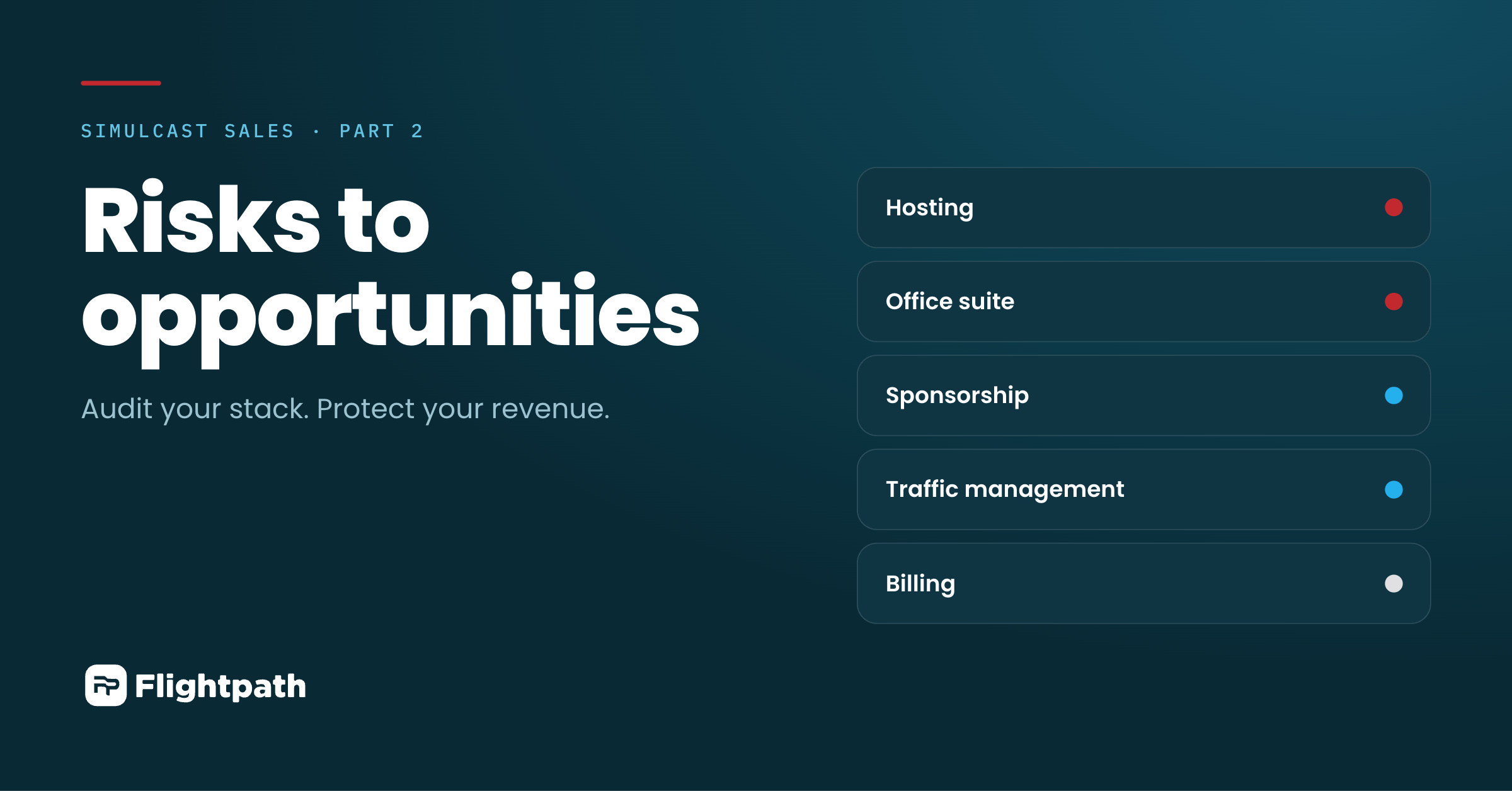
It begins with identifying the components of your technology stack, which is not as challenging as it might sound. Below are the first five lines from the stack audit of my publishing company, Fable and Folly. I’ve included an overly simplified risk and mitigation summary for each.
Fable and Folly: Commercial Alignment
Sponsorship platforms & partners: Megaphone, Art19, RedCircle, AdsWizz and YouTube. Risk: Medium. Mitigation: Diversify sponsorship partners to minimize negative impact on us and the producers we represent.
Office suite: Google Workspace for managing delivery and campaign reports. Risk: High. Mitigation: Difficult without a full-featured alternative. Loss of Sheets and Documents would hurt the business.
Billing software: QuickBooks Online. Risk: Low. Mitigation: Offline procedures maintained with all data stored locally monthly for manual billing if needed.
Fable and Folly: Delivery and Visibility
Hosting platforms: Megaphone, Art19, YouTube. Risk: High. Potential for misalignment of incentives on all of these platforms. Mitigation: Maintain multi-platform footprint to help lower impact of a significant event on any one platform. Noted: YouTube lock-in is not mitigable but we can explore and be present in other video channels.
Traffic Management: Flightpath. Risk: Medium. Mitigation: Maintain backup procedures in the event of an outage or failure.
Audit, Step One: Identify Stack Components
Make a list of all the tools your teams use to communicate with buyers, producers, staff and vendors. You can do this in a chat thread or on a call with a few folks from each of your key teams, such as Ad Ops, Sales and Billing. It’s important to get people in these roles to participate.
My favourite way to do this, and it works surprisingly well, is to walk through a sponsorship buy from start to finish. Or if you don’t sell sponsorships, walk through onboarding a new show. The key is to start at the very beginning. I’ll use sponsorship as an example.
Deal creation. How do we find out about a sales opportunity? Is it always an inbound request, or do we reach out to buyers? Is it one type of buyer, like an agency, or multiple types? What documents do we receive? What documents do we send?
Inventory. How do we determine availability? How does this change across the platforms we sell sponsorship for? How is this communicated to the buyer?
Booking and Trafficking. What happens when a deal is signed? How are Insertion Orders stored? How does Ad Ops receive the booking information, and where is it stored? Who traffics the campaigns and how are Sales and the buyer kept in the loop?
Trafficking and Reporting. Who enters campaigns into the DAI platform? Where do we track the status of what is ready to traffic? How is this relayed to other roles such as sales or billing? What happens where there are questions or inventory is no longer available?
Billing. How are accounts receivable managed? What are your payment terms and accepted forms of payment? Who monitors outstanding balances and what are the processes to communicate with buyers and collect past due amounts?
This is just one example of the types of questions that might apply. I get that this might feel a little daunting, but in my experience, once you get your team started, it gains momentum as people get excited to finally see the entire flow in black and white.
It’s important to follow a process from the very beginning to the very end, as that will reveal disconnects, and even unknown tools that your team is relying on. It will also uncover where confusion lies in some handovers or artifacts being provided to a team that they are ignoring or don’t understand. And later it will form the basis of the technology stack for your firm.
Jot down the steps and tools as they come up. The key is to capture it all. Afterward, or during the meeting if there is time, you can quickly group these into common platform categories. Spreadsheets and email can be grouped as “Office Suite Tools”. Third-party measurement can be called just that.
Audit, Step Two: Prioritize and Strategize
I recommend taking a break and sitting with the output from Step One for a day or two, so you can come back to it with fresh eyes. Then, prioritize it into no more than ten most important items that form the foundation of your technology stack. We’re going to take each of these and assess the risks and mitigation strategies that apply to our business.
This is done in three stages.
a) What happens if there is an outage, or this service is no longer aligned with our interests?
b) What is the potential impact to the business?
c) What mitigation strategies can we bring to bear in such a situation? How long can we lessen or avoid the impacts of an outage or loss of critical services, and at what cost?
The output can be simple statements, like I shared in the Fable and Folly example above, or whole paragraphs, as best fits your needs.
The key is to engage in conversation around the mitigation strategies and level of risk to your organization for each item in your stack. Higher-risk items are ones where the available mitigation options will result in significant negative impacts to your business.
Some might argue this is a gross over-simplification of a stack audit. As a reformed consultant, I’ve been involved in lengthy and very expensive engagements that appeared, by word count and binder weight, to be a very comprehensive stack assessment. But inevitably, all that work ended up gathering dust on someone’s cubicle shelf.
The best stack audits are simple, clear and accessible. They empower change by giving teams insight into where risk lies, and help direct everyone on building a stronger foundation for the business, providing greater resilience and growth potential.
Step Three (Optional): For the Business Nerds
For those wanting a bit more to chew on, I’m sharing some of the questions I’ve found super useful when assessing the risks to a new media business.
This should be done as a separate exercise, generally with a different and likely more senior team. It can be done before or after the team exercise outlined in Steps One and Two above. Different platforms and risks will emerge from each and they can all be combined into one technology stack assessment.
Questions:
Commercial alignment. Review every platform we use for hosting and monetization and ask: How does each platform benefit financially from our business? Where might there be a conflict of interest? What “outs” do we have in our contract where we can cite such conflicts of interest as grounds for terminating the agreement?
Delivery. What platforms or software tools does our team rely on for monitoring delivery? What is required for our team to identify and explain under-delivery on a campaign? What happens if these tools are no longer available?
Inventory management. How do revenue leaders evaluate inventory capacity (how much is available to sell across the portfolio) and identify opportunities for growth? Does the sales team have access to reliable inventory availability? How do you protect the high-value inventory while finding new ways to add incremental revenue and improve sell-through?
Support. On what platforms do we have service level agreements? What quality of support are we actually receiving? How fast of a response do we receive when revenue is impacted? How experienced and knowledgeable is their support or account team?
Adaptability. What would happen if we suddenly had to leave one of the hosting platforms we use with less than 30 days’ notice? Is this even possible? What other platforms might pose a risk to us if we had to terminate them on short notice? How rapidly can our current stack adapt to a new platform?
These questions are going to surface both risks (impacts) and platforms/partners.
And there are many ways to facilitate this type of assessment, but that is out of the scope of this article. Even a single senior executive, just sitting with these questions, can often give new insights into the risks to the business and a way to provide guidance on where mitigation might need more work.
Choosing a Software Partner
If you find yourself in a multi-year contract negotiation with a software partner, do your homework and know the risks and mitigation strategies you plan to implement. This lets you better negotiate the exit clauses and service level terms that protect your business.
Risk is not new to media companies. We deal with risk on every insertion order, representation contract and minimum guarantee we sign. But we’re not always as comfortable with the idea that our choice of hosting platforms is also a potential risk factor. And I expect a lot of publishers don’t think of their partners or platforms as part of their technology stack.
Using the approach outlined above can enable you to better identify the partners and strategies that position your firm for the future, while lowering risk to your business.
And the benefits go beyond stability. A solid technology stack can enable your organization to support that amazing creator who happens to be on a different platform, to easily update your sponsorship packages to meet changing platform configurations, and even mitigate outages without having to rebuild your sales, operations or billing processes. Your business can move with more confidence and speed in a fragmented media space that is evolving at a breakneck pace.
Continue the Conversation
At Flightpath we have been supporting publishers with tools to streamline sales and operations for over 5 years. We’ve co-evolved as we learn what strategies work and witness the impacts across our client base.
A little about us: we reinvented order management by layering traffic management on top of the leading cross-platform inventory prediction engine in the industry. We provide inventory management, consolidated reporting, real-time availability and forecasting built to support simulcast sales strategies. Not to mention our white glove consulting support from leaders in podcast operations and revenue.
I’d love to learn about the pressures you face. Or chat about your experience addressing simulcast monetization for your business.
Email me at: sean.howard@flightpath.fm